
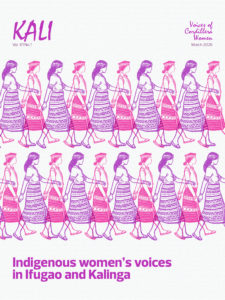
In this issue of Kali: Voices of Indigenous Women, we intend to update advocates of Indigenous women’s rights and the general public on specific domains of the women’s situation in the Cordillera. We hope to regularize and expand this content in the upcoming issues of Kali starting this year, to cover other aspects of women’s issues in the socio-economic, political, and cultural spheres, and to include the other provinces and Baguio City.
The information shared in this issue come from Indigenous women in the provinces of Ifugao (specifically, barangays Tupaya and Dulao in the municipality of Lagawe, Banga in the municipality of Lamut) and Kalinga (specifically, barangays Apatan and Limos in the municipality of Pinukpuk). We gathered the data in 2024 and 2025. Our outputs included (1) a policy brief exploring the links between gender-based violence and environmental issues in Apatan and Limos, and (2) a gender analysis report on Tupaya and Dulao. We now share these outputs in this issue of Kali which is a collaboration with Innabuyog.
The five barangays cited above are affected by large-scale energy applications, including the project to develop the Alimit Hydropower Complex in Ifugao
and the projects to dam the Saltan river in Kalinga. The implementation of the said projects has been stalled because of the resistance of the affected Indigenous communities. In the FPIC processes for both the Alimit and Saltan projects, the women participated actively and registered their opposition, outrightly denying the projects their consent.
The women of Apatan and Limos belong to the Limos tribe of the Kalinga Indigenous group. The women of Tupaya and Dulao largely belong to the Ayangan Indigenous group.
In our data gathering, we looked into access and control of assets and resources, power, representation and decision-making, environmental pressures and threats, and vulnerabilities. The women of Apatan and Limos articulated needs and aspirations as well as actionable recommendations.
We found positive aspects of local custom that enabled Indigenous women’s empowerment – for example, in regard to the ownership of land and other
resources. We found that there was no gender bias in inheritance rights; rather, inheritance among the Ayangan was determined by order of birth, and among the Kalinga, by the contribution of each offspring to working the land.
We also found, however, areas needing fundamental change, such as in the resolution of cases of violence against women (VAW). Kalinga respondents shared that women in their communities maximized mechanisms available in the barangay or municipal government, and in the Department of Social Welfare Development (DSWD), whenever VAW cases could not be resolved by the community’s elders and the families of the victims and the perpetrators. The practice of resorting to amicable settlement prevailed among both the Kalinga and the Ayangan, unjustly reducing the issue of VAW to a pecuniary matter. State VAW was also documented among the Kalinga respondents, who experienced redtagging and harassment from the Philippine Army encamped in their communities.
CWEARC and Innabuyog support the specific recommendations conveyed by the Indigenous women who took part in the two research endeavors. We
emphasize the need to promote Indigenous values and practices that empower women in terms of resource ownership and access, leadership and decision making. We also emphasize that amicable settlement of VAW cases must be challenged and disallowed, because this always favors the perpetrators and never the victims. Available mechanisms in government structures and domestic laws must be made known to the communities – especially the women – by the relevant government agencies.
We are indebted to the German Embassy in Manila for supporting the research carried out in Kalinga; the Asia Indigenous Peoples Pact (AIPP) and the
International Working Group on Indigenous Affairs (IWGIA) for supporting the research done in Ifugao; the Equality Fund for supporting the publication of this issue of Kali.
To request for your copies, please send us a message at cwearc@cwearc.org and info@cwearc.org and kindly answer this form. Thank you! https://docs.google.com/forms/d/e/1FAIpQLSe90EN_rBs9MqMgxqSNqeeeA75YtwJT6tCzVQxDQeGdC9AYBA/viewform?usp=header