
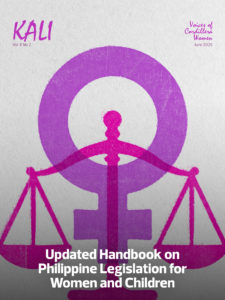
CWEARC first published the handbook on women’s laws in 2006. Since then, new laws for the protection of women and children in the Philippines were passed in Congress and enacted. We owe it to the vibrant women’s movement in the Philippines that these laws were enacted, and we also owe it to our champions in Congress for making sure that the house bills were fought for, until these were eventually passed. Specifically, we acknowledge and laud the Gabriela Women’s Party (GWP) for being the voice of women in the House of Representatives since 2004. GWP authored and supported landmark laws for women and children’s right such as the Anti-Trafficking in Persons Act of 2003, Anti-Violence Against Women and Their Children Act of 2004, Magna Carta of Women (RA 9710), Expanded Maternity Leave Law (RA 11210), Expanded Solo Parents Welfare Law (RA 11861), Occupational Safety and Health Standards Law (RA 11058), Safe Spaces Act (RA 11313) and the Anti-Child Pornography Act (RA 9775).
In our engagement with communities, education on violence against women and the laws for the protection of women and children remain vital and relevant. The conversations and discussions we had with the women and their communities demonstrated the continuing need to facilitate empowerment on women’s rights, particularly laws for women. Similarly, we encountered persistent challenges, such as prevailing norms on VAW and rape. It is therefore of utmost significance that knowledge of the laws for women and children, as well as the services and remedies available to them, be urgently disseminated. At the same time, it is important to strengthen the existing laws — it is in this regard that we are including in this handbook highly relevant policy recommendations by distinguished bodies on women’s rights such as the Center for Women’s Rights (CWR), Philippine Commission on Women (PCW), UN Women, the International Development Law Organization (IDLO) and of course, GWP.
This handbook is intended for women’s organizations wherever, local government units especially at the barangay level, educators and advocates who tirelessly fight for women’s rights, particularly working for women’s access to justice and eliminating barriers to accessing justice.
IEC and knowledge sharing will continue to be our priorities in facilitating women’s empowerment. We are grateful to the International Work Group on
Indigenous Affairs (IWGIA) for making this project possible.
To request for your copies, please send us a message at cwearc@cwearc.org and info@cwearc.org and kindly answer this form. Thank you! https://docs.google.com/forms/d/e/1FAIpQLSe90EN_rBs9MqMgxqSNqeeeA75YtwJT6tCzVQxDQeGdC9AYBA/viewform?usp=header